
 English
 Tiếng Việt
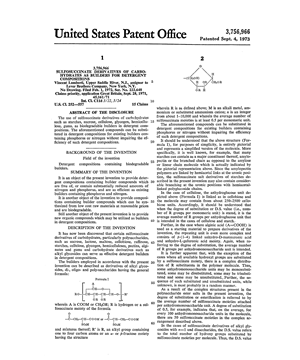
(en)THE USE OF SULFOSUCCINATE DERIVATIVES OF CARBOHYDRATES SUCH AS STARCHES, SUCROSE, CELLULOSE, GLYCOGEN, HEMICELLULOSE, GUMS, AS BIODEGRADABLE BUILDERS IN DETERGENT COMPOSITIONS. THE AFOREMENTIONED COMPOUNDS CAN BE SUBSTITUTED IN DETERGENT COMPOSITIONS FOR EXISITING BUILDERS CONTAINING PHOSPHORUS OR NITROGEN WITHOUT IMPARING THE EFFICIENCY OF SUCH DETERGENT COMPOSITIONS.
1.ApplicationNumber: US-3756966D-A
1.PublishNumber: US-3756966-A
2.Date Publish: 19730904
3.Inventor: LAMBERTI V,US
4.Inventor Harmonized: LAMBERTI V()
5.Country: US
6.Claims:
(en)THE USE OF SULFOSUCCINATE DERIVATIVES OF CARBOHYDRATES SUCH AS STARCHES, SUCROSE, CELLULOSE, GLYCOGEN, HEMICELLULOSE, GUMS, AS BIODEGRADABLE BUILDERS IN DETERGENT COMPOSITIONS. THE AFOREMENTIONED COMPOUNDS CAN BE SUBSTITUTED IN DETERGENT COMPOSITIONS FOR EXISITING BUILDERS CONTAINING PHOSPHORUS OR NITROGEN WITHOUT IMPARING THE EFFICIENCY OF SUCH DETERGENT COMPOSITIONS.
7.Description:
(en)United States Patent 3,756,966 SULFOSUCCINATE DERIVATIVES OF CARBO- HYDRATES AS BUILDERS FOR DETERGENT COMPOSITIONS Vincent Lamberti, Upper Saddle River, N.J., assignor to Lever Brothers Company, New York, NY.
No Drawing. Filed Feb. 1, 1972, Ser. No. 222,648 Claims priority, application Great Britain, Sept. 28, 1971, 45,161/ 71 Int. Cl. Clld 3/22, 3/24 US. Cl. 252-557 15 Claims ABSTRACT OF THE DISCLOSURE The use of sulfosuccinate derivatives of carbohydrates I such as starches, sucrose, cellulose, glycogen, hemice1lulose, gums, as biodegradable builders in detergent compositions. The aforementioned compounds can be substituted in detergent compositions for existing builders containing phosphorus or nitrogen without impairing the efficiency of such detergent compositions.
BACKGROUND OF THE INVENTION Field of the invention Detergent builders.
SUMMARY OF THE INVENTION DESCRIPTION OF THE INVENTION It has now been discovered that certain sulfosuccinate derivatives of carbohydrates, particularly polysaccharides, such as sucrose, lactose, maltose, cellobiose, rafiinose, starches, cellulose, glycogen, hemicelluloses, pectins, alginates and gums and carbohydrate derivatives such as alkyl glycosides can serve as eliective detergent builders in detergent compositions.
The builders employed in accordance with the present invention can be described as derivatives of alkyl glycosides, di-, oligoand poly-saccharides having the general formula:
compositions containing biodegradable Formula I wherein A is COOM or CH OR; R is hydrogen or a sulfosuccinate moiety of the formula and mixtures thereof; R is R, an alkyl group containing one to four carbon atoms or an aor fi-fructose moiety having the structure wherein R is as defined above; M is an alkali metal, ammonium or substituted ammonium cation; n is an integer from about 1-10,000 and wherein the average number of sulfosuccinate moieties is at least 0.5 per monomeric unit.
The aforementioned compounds can be substituted in detergent compositions for existing builders containing phosphorus or nitrogen without impairing the efiiciency of such detergent compositions.
It should be understood that the above structure (Formula I), for purposes of simplicity, is entirely pictorial and represents a simplified version of the molecule. More specifically, it is well known, for example, that many starches can contain as a major constituent thereof, amylopectin or the branched chain as opposed to the amylose or linear chain molecule which is actually indicated by the pictorial representation above. Since the amylopectin polymers are linked by hemiacetal links at the uronic position, the sulfosuccinate salt derivatives of starches described in the present invention may also contain considerable branching at the uronic positions with hemiacetallinked polyglucoside chains.
In the case of cellulose, the anhydroglucose unit depicted above (Formula I) is linked as in cellobiose and the molecule may contain from about 250-2500 cellobiose units. Accordingly, it should be understood that when the degree of substitution or D.S. value (i.e., number of R groups per monomeric unit) is stated, it is the average number of R groups per anhydroglucose unit that is intended in the cases of cellulose and starch.
Further, in the case where alginic acid (A=COOH) is used as a starting material to prepare derivatives of the invention, the repeating unit is even more complex and consists of [3-(14) linked anhydro-D-mannuronic acid and anhydro-L-guluronic acid moiety. Again, when referring to the degree of substitution, the average number of R groups per anhydromonosaccharide unit is intended.
It is further apparent that, with the exception of the cases where all available hydroxyl groups are substituted by a sulfosuccinate moiety, there is a complex distribution of R substituents in the polymer molecule. Thus, some anhydromonosaccharide units may be monosubstituted, some may be disubstituted, some may be trisubstituted and some may be unsubstituted. Further, the sequence of such substituted and unsubstituted units, while unknown, is most probably in a random manner.
As a result of the complex structures present in the polysaccharide ester salts in the present invention, the degree of substitution or esterification is referred to by the average number of sulfosuccinate moieties attached per anhydromonosaccharide unit. A degree of substitution of 0.5, for example, indicates that, on the average, for every anhydromonosaccharide units in the molecule, there are 50 sulfosuccinate moieties in the complex arrangement described above.
In the cases of sulfosuccinate derivatives of alkyl glycosides with n=1 and disaccharides, the BS. value refers to the total number of hydroxy groups substituted by sulfosuccinate moieties per molecule. Thus, the D5. value may be as high as 4 in the alkyl glycoside derivatives and as high as 8 in the disaccharide derivatives.
It has been found that effective detergent-building properties are afforded when the polysaccharide sulfosuccinate salts of the present invention have a degree of substitution (D.S. value) of from about 0.5-3, preferably about 1-3 and more preferably, 1.5-3. In the cases of the sulfosuccinate salts of the disaccharides, effective detergentbuilding properties are afforded when the BS. value is from about 1 to 8 and preferably from about 2 to 8. In the cases of the sulfosuccinate derivatives of the alkyl glycosides, the effective detergent building properties are afforded when the D8. value is from about 1 to 4 and preferably from about 2 to 4.
The alkali metal and ammonium salts of the sulfosuccinate derivatives (Formula I) are obtained by reacting the appropriate alkali metal sulfite or bisulfite or ammonium sulfite or bisulfite with the corresponding maleic acid ester derivative of the carbohydrate. The maleic acid ester, in turn, is prepared by heating the particular carbohydrate with maleic anhydride in a suitable solvent medium such as toluene and, after solvent removal, purified by washing either with water or dilute mineral acid. The D.S. value is controlled by the ratio of maleic anhydride to starting carbohydrate used. In the cases where the maleic acid ester is water soluble, the product is purified by first dissolving in water and neutralizing the pH 8-8.6 with an alkali metal bicarbonate or carbonate, evaporating to dryness and then extracting with a lower alcohol (e.g. methanol or ethanol) to separate the desired product from maleate salts. Alternatively, an aqueous solution or slurry of a sulfosuccinate salt, e.g. the disodium salt, may be acidified to about pH=4 with mineral acid and the acid salt thus formed (e.g. carbohydrate residue precipitated or extracted with a lower alcohol and then isolated by filtration or evaporation, respectively. An aqueous solution or slurry of the acid salt is then neutralized to a pH of -8-8.6 with the desired base: e.g. potassium hydroxide, sodium bicarbonate, lithium carbonate, ammonium hydroxide, tetramethylammonium hydroxide, monoethanolamine, diethanolamine, triethanolamine and morpholine to form the corresponding alkali metal, ammonium or substituted ammonium salts.
The preferred cations for use in the compositions of the present invention are alkali metal, alkanolammonium (i.e., mono-, diand tri-ethanolammonium), ammonium and mixtures thereof. Those especially preferred are sodium, potassium and triethanolammonium, although any cation which will solubilize the carbohydrate sulfosuccinates is suitable for use in the present invention.
Any carbohydrate, especially polysaccharides, containing hydroxy groups may be used as a starting material for forming the derivatives used in the present invention including such substances as the (C to C alkyl glycosides, exemplified by methyl and ethyl glucopyranosides; disaccharides, exemplified by sucrose, lactose, maltose and cellobiose, trisaccharides such as raffinose; oligosaccharides, exemplified by those obtainable by enzymatic -hydrolysis of corn starch and cellulose; polysaccharides, exemplified by glycogen, starches such as those derived from corn, potato, rice, arrowroot, tapioca, wheat, sago, etc., cellulose, hemicelluloses, polyuronic acids, dextrans, pectins, alginic acid and natural gums such as arabic and acacia as well as any of the aforementioned carbohydrates that may be modified by etherification, carboxymethylation or cross-linking. The preferred sulfosuccinate derivatives used in the composition of the present invention are the disodium sulfosuccinate ester derivatives of starch, hydrolyzed starch, cellulose and sucrose.
According to the present invention, excellent cleaning results can be obtained by using the builders described above with a wide range of detergent surface active materials and mixtures thereof. The builders can be used singularly, in combination with each other as the sole builder in the detergent composition or in combination with other builders such as sodium nitrilotriacetate, sodium ethylenediaminetetraacetate, sodium tripolyphosphate, sodium and potassium pyrophosphate, sodium polyacrylate, oxidized starches, trisodium citrate, trisodium carboxymethyloxysuccinate and alkali metal carbonates.
In the detergent compositions of the present invention, the only essential ingredients are the detergent surface active material and the builder. The weight percent of the builder present in the detergent compositions will range from about 5 to about and preferably from about 20 to about 60% and more preferably 35-50% by weight of the total weight of the composition. When expressed as a weight ratio of builder to surfactant, the builders used in the instant invention will generally be present in a ratio of about 1:10 to about 10:1, and preferabl 2:1- 5:1 depending on the end use or whether a heavy-duty or light-duty detergent is desired.
Similarly, in detergent compositions suitable for washing dishes in mechanical dishwashers, the ratio of builder to detergent may be as high as 50:1.
In addition to having detergent building properties, the sulfosuccinate derivatives of the polysaccharides described in the present invention may also be used as anti-redeposition agents in detergent compositions. When used for such purposes, the sulfosuccinate polysaccharide derivative is generally present in minor amounts in relation to the total weight of the composition. For example, as a rule, when employed as an antiredeposition agent, the polysaccharide derivatives of the invention will generally comprise up to 5% (preferably 1-3%) of the total weight of the detergent composition.
The detergent surface active compounds which can be used in the compositions of this invention include anionic, nonionic, zwitterionic, ampholytic detergent compounds and mixtures thereof. These suitable substances are outlined at length below.
(a) Anionic detergent compositions which can be used in the compositions of this invention include both soap and non-soap detergent compounds. Examples of suitable soaps are the sodium, potassium, ammonium and alkylolammonium salts of higher fatty acids (C -C Particularly useful are the sodium or potassium salts of the mixtures of fatty acids derived from coconut oil and tallow, i.e., sodium or potassium tallow and coconut soap and tall oil soap. Examples of anionic organic non-soap detergent compounds are the water soluble salts, alkali metal salts of organic sulfuric reaction products having in their molecular structure an alkyl radical containing from about 8 to about 22 carbon atoms and a radical selected from the group consisting of sulfonic acid and sulfuric acid ester radicals. (Included in the term alkyl is the alkyl portion of higher acyl radicals.) Important examples of the synthetic detergents which form a part of the compositions of the present invention are the so dium or potassium alkyl sulfates especially those obtained by sulfating the higher alcohols (C -C carbon atoms) produced by reducing the glycerides of tallow or coconut oil; sodium or potassium alkyl benzenesulfonates in which the alkyl group contains from about 9 to about 20 carbon atoms and in which the benzene ring is attached to the alkyl chain at either the one position or at the secondary positions such as in sodium linear secondary (C -C alkyl benzenesulfonate, sodium p-(2-dodecyl)benzenesulfonate, sodium p-(2-octadecyl)benzenesulfonate, sodium p-(3-dodecyl)benzenesulfonate and 3-phenyldodecanesulfonate; sodium alkyl glyceryl ether sulfonates, especially those ethers of the higher alcohols derived from tallow and coconut oil and synthetic alcohols derived from petroleum; sodium coconut oil fatty acid monoglyceride sulfates and sulfonates; sodium or potassium salts of sulfuric acid esters of the reaction product of one mole of a higher fatty alcohol (e.g., tallow or coconut oil alcohols) and about 1 to 6 moles of ethylene oxide per molecule and in which the alkyl radicals contain about 9 to about 18 carbon atoms; the reaction product of fatty acids esterified with isethionic acid and neutralized with sodium hydroxide where, for example, the fatty acids are derived from coconut oil; sodium or potassium salts of fatty acid amides of methyl taurine in which the fatty acids, for example, are derived from tallow; alkane sulfonates such as those derived by reacting alpha-olefins containing 8 to 20 carbon atoms with sodium bisulfite and those derived by reacting parafiins with S and C1 and then hydrolyzing with a base to produce a random sulfonate; alphaolefin sulfonates such as those derived by reacting alphaolefins with S0 and then neutralizing the reaction product; and others known in the art.
(b) Nonionic synthetic detergents may be broadly defined as compounds which do not ionize in water solution. For example, a Well-known class of nonionic synthetic detergents is made available on the market under the trade name of Pluronic. These compounds are formed by condensing ethylene oxide with an hydrophobic base formed by the condensation of propylene oxide with propylene glycol. The hydrophobic protion of the molecule which, of course, exhibits water insolubility has a molecular weight of from about 1,500 to 1,800. The addition of polyoxyethylene radicals to this hydrophobic portion tends to increase the water solubility of the molecule as a'whole and the liquid character of the product is retained up to the point where polyoxyethylene content is about 50% of the total weight of the condensation product.
Other suitable nonionic synthetic detergents include:
(1) The polyethylene oxide condensates of alkylphenols, e.g., the condensation products of alkylphenols having an alkyl group containing from about 6 to 12 carbon atoms in either a straight chain or branched chain configuration, with ethylene oxide, the said ethylene oxide being present in amounts equal to to 25 moles of ethylene oxide per mole of alkylphenols. The alkyl substituent in such compounds may be derived from polymerized propylene, di-isobutylene, octene, dodecene or nonene, for example.
(2) Those derived from the condensation of ethylene oxide with the product resulting from the reaction of propylene oxide and ethylenediamine. For example, compounds containing from about 40% to about 80% polyoxyethylene by weight and having a molecular weight of from about 5,000 to about 11,000 resulting from the reaction of ethylene oxide groups with a hydrophobic base constituted of the reaction product of ethylene diamine and excess propylene oxide, said hydrophobic base having a molecular weight of the order to 2,500 to 3,000, are satisfactory.
(3) The condensation product of primary or secondary aliphatic alcohols having from 8 to 18 carbon atoms, in either straight chain or branched chain configuration, with ethylene oxide, e.g., a coconut alcohol-ethylene oxide condensate having from 3 to 30 moles of ethylene oxide per mole of coconut alcohol, the coconut alcohol fraction having from 10 to 14 carbon atoms; a random linear secondary alcohol containing 11-15 carbon atoms derived from n-parafiins and condensed with 3-20 moles of ethylene oxide per mole of the alcohol.
(4) Long chain tertiary amine oxides corresponding to the following general formula, R R R N- 0, wherein R is an alkyl radical of from about 8 to 18 carbon atoms and R and R are each methyl, ethyl or hydroxy ethyl radicals. The arrow in the formula is a conventional representation of a semi-polar bond. Examples of amine oxides suitable for use in this invention include dimethyldodecylamine oxide, dimethyloctylamine oxide, dimethyldecylamine oxide, dimethyltetradecylamine oxide and dimethylhexadecylamine oxide, N-bis (hydroxyethyl)dodecylamine oxide.
(5) Long chain tertiary phosphine oxides corresponding to the following formula RRR"P O, wherein R is an alkyl, alkenyl or monohydroxyalkyl radical ranging from 10 to 18 carbon atoms in chain length and R' and R" are each alkyl or monohydroxyalkyl groups containing from 1 to 3 carbon atoms. The arrow in the formula is a conventional representation of a semi-polar bond. Examples of suitable phosphine oxides are:
dimethyldodecylphosphine oxide, dimethyltetradecylphosphine oxide, ethylmethyltetradecyclphosphine oxide, cetyldimethylphosphine oxide, dimethylstearylphosphine oxide, cetylethylpropylphosphine oxide, diethyldodecylphosphine oxide, diethyltetradecylphosphine oxide, bis(hydroxymethyl)dodecylphosphine oxide, bis(2-hydroxyethyl)dodecylphosphine oxide, 2-hydroxypropylmethyltetradecylphosphine oxide, dimethyloleylphosphine oxide, and dimethyl-2-hydroxydodecylphosphine oxide.
(6) Dialkyl sulfoxides corresponding to the following formula, RR'S 0, wherein R is an alkyl, alkenyl, betaor gamma-monohydroxyalkyl radical or an alkyl or betaor gamma-monohydroxyalkyl radical containing one or two other oxygen atoms in the chain, the R groups ranging from 10 to 18 carbon atoms in chain length, and wherein R is methyl, ethyl or alkylol. Examples of suitable sulfoxide compounds are:
dodecyl methyl sulfoxide,
tetradecyl methyl sulfoxide,
3-hydroxytridecyl methyl sulfoxide, 2-hydroxydodecyl methyl sulfoxide, 3-hydroxy-4-decyloxybutyl methyl sulfoxide, 3-hydroxy-4-dodecyloxybutyl methyl sulfoxide, 2-hydroxy-3-decyloxypropyl methyl sulfoxide, 2-hydroxy-3-dodecyloxypropyl methyl sulfoxide, dodecyl ethyl sulfoxide,
Z-hydroxydodecyl ethyl sulfoxide, and dodecyI-Z-hydroxy ethyl sulfoxide.
(c) Ampholytic synthetic detergents can be broadly described as derivatives of aliphatic secondary and tertiary amines, in which the aliphatic radical may be straight chain or branched and wherein one of the aliphatic substituents contains from about 8 to 18 carbon atoms and one contains an anionic water solubilizing group. Examples of compounds falling within this definition are sodium-3-dodecylaminopropionate and sodium-3-dodecylaminopropanesulfonate and sodium N-Z-hydroxydoecyl- N-methyl-taurate.
(d) Zwitterionic synthetic detergents can be broadly described as derivatives of aliphatic quaternary ammonium compounds, sulfonium compounds and phosphonium compounds in which the aliphatic radical may be straight chain or branched and wherein one of the aliphatic substituents contains from about 8 to 18 carbon atoms and one contains an anionic water solubilizing group. Examples of compounds falling within this definition are 3- (N,N-dimethyl-N-hexadecylammonio propanel-sulfonate, 3-(N,N-dimethyl-N-hexadecylammonio)-2-hydroxypropane l-sulfonate, 3-(dodecylmethylsulfonium)propane sulfonate, and 3-(cetylmethylphosphonium)ethane sulfonate.
In addition to the essential ingredients in the detergent composition, other optional ingredients may also be added. Examples of the optional ingredients are perfumes, colorants, fabric softening agents, fungicides, germicides, enzymes, fluorescent dyes, antiredeposition agents, hydrotropes and in the case of liquid compositions, opacifiers and organic solvents. Other ingredients such as bleaches, i.e., sodium perborate with or without activators, active chlorine compounds and inorganic salts such as sodium carbonate, sodium bicarbonate, sodium sulfate, sodium chloride and sodium silicate may also be present.
The detergent compositions of the present invention can be utilized in washing solutions over a pH range of from about 7-11 and more preferably 8-10.
Example 1 and Table I further illustrate the present invention. The detergent formulations set forth in the table represent detergent Compositions containing an anionic surface active agent in combination with builders of the present invention and also standard phosphate builders. The compositions were prepared by blending together the recited components in the proportions indicated, including an anticorrosion agent and buffering agent (sodium silicate) and adjusting the indicated pH where necessary by the addition of sodium hydroxide. The compositions were then tested for detergency or cleaning ability in the Terg-O-Tometer test wherein washing conditions are as indicated and the results reported as detergency units. The average detergency units (DU) of the formulation is the final reflectance value of the washed cloth minus the initial reflectance of the soiled cloth (the average of two runs), the reflectance value being obtained by measurement with a Gardner automatic color difference meter.
EXAMPLE 1 Starch sulfosuccinate Corn starch-maleic acid ester 10 g. (0.041 mole) having a D.S. value of 0.80 is suspended in 100 ml. of water and the pH adjusted to about 7 with sodium carbonate. To 'this mixture is added 5.4 g. (0.052 mole) of sodium bisulfite. After readjusting the pH to 7 the mixture is stirred for 1 hour at room temperature and then heated at 50 C. for 3 hours. The pH is then adjusted to 8.5 and starch sulfosuccinate having a D.S. value of 0.8 is obtained by precipitating the product with ethyl alcohol, decanting the liquid, washing the residue with additional ethyl alcohol and finally drying the residue obtained.
sulfosuccinate derivatives of other carbohydrates may be afforded using the above procedure by substituting in place of corn starch-maleic acid ester the appropriate maleic acid ester of the desired di-, oligoor polysaccharide or alkyl glycoside.
TABLE I.DETERGENCY BUILDING PROPERTIES OF STARCH SULFOSUCCINATE [Washing conditions: Terg-O-Tometer, dacron/cotton soil cloth (vacuum cleaner dust); 120 F., 180 p.p.m. 2:1 Ca /Mg water; pH=10; 0.2% formulation concentration] Formulation (percent) Component 1 2 Disodium starch sulfosuccinate D.S =0 8 Pentasodium tripolyphosphate- Sodium silicate solids (2.4/1 Slot/N820) LAS (sodium linear secondary (Cw-C) alkyl beuzenesultonate) 5. Water Detergency (DUs) Percent efiicicncy rela ve to control formulation the general formula,
RO OHGHGH- 11-0 -11 L R OR 11 wherein A is COOM or CH OR; R is hydrogen or a sulfosuccinate moiety of the general formula and mixtures thereof, M is an alkali metal, ammonium or substituted ammonium cation; R is R, an alkyl group containing one to four carbon atoms or an aor ,8-fructose moiety having the structure H -(CH;OH)
H OR CH OR wherein R is as defined above; M is an alkali metal, ammonium or substituted ammonium cation; n is an integer from about 110,000 and wherein the D.S. value is at least 0.5 per monomeric unit.
3. A composition of claim 2 wherein the builder is an alkali metal sulfosuccinate derivative of a polysaccharide selected from the group consisting of starches and cellulose wherein the D.S. value ranges from about 1-3.
4. A composition of claim 3 wherein the detergent is an anionic surface active agent.
5. A composition of claim 3 wherein the detergent is a nonionic surface active agent.
6. A composition of claim 3 wherein the builder represents from about 20-60% of the total weight of the composition.
7. A composition of claim 2 wherein the builder is an alkali metal sulfosuccinate derivative of an oligosaccharide selected from the group consisting of hydrolyzed starches and cellulose wherein the D.S. value ranges from about 1-3.
8. A composition of claim 7 wherein the detergent is an anionic surface active agent.
9. A composition of claim 7 wherein the detergent is a nonionic surface active agent.
10. A composition of claim 7 wherein the builder represents from about 2060% of the total weight of the composition.
11. A composition of claim 2 wherein the builder is a sulfosuccinate derivative of a disaccharide selected from the group consisting of sucrose, lactose, maltose and cellobiose wherein the D.S. value ranges from about l-8.
12. A composition of claim 11 wherein the detergent is an anionic surface active agent.
13. A composition of claim 11 wherein the detergent is a nonionic surface active agent.
14. A composition of claim 11 wherein the builder represents from about 2060% of the total weight of the composition.
15. A composition of claim 2 wherein the builder is a sulfosuccinate derivative of a glycoside wherein R is an alkyl group containing 1-4 carbon atoms and the D.S. value is from about 1 to about 4.
(References on following page) 9 References Cited UNITED STATES PATENTS 2,825,727 3/1958 Caldwell 260-2335 X 3,533,944 10/1970 Yuan 252-557 X 5 3,629,121 12/ 1971 Eldib 252-89 10 LEON D. ROSDOL, Primary Examiner H. A. PITLICK, Assistant Examiner us. 01. X.R.
1.PublishNumber: US-3756966-A
2.Date Publish: 19730904
3.Inventor: LAMBERTI V,US
4.Inventor Harmonized: LAMBERTI V()
5.Country: US
6.Claims:
(en)THE USE OF SULFOSUCCINATE DERIVATIVES OF CARBOHYDRATES SUCH AS STARCHES, SUCROSE, CELLULOSE, GLYCOGEN, HEMICELLULOSE, GUMS, AS BIODEGRADABLE BUILDERS IN DETERGENT COMPOSITIONS. THE AFOREMENTIONED COMPOUNDS CAN BE SUBSTITUTED IN DETERGENT COMPOSITIONS FOR EXISITING BUILDERS CONTAINING PHOSPHORUS OR NITROGEN WITHOUT IMPARING THE EFFICIENCY OF SUCH DETERGENT COMPOSITIONS.
7.Description:
(en)United States Patent 3,756,966 SULFOSUCCINATE DERIVATIVES OF CARBO- HYDRATES AS BUILDERS FOR DETERGENT COMPOSITIONS Vincent Lamberti, Upper Saddle River, N.J., assignor to Lever Brothers Company, New York, NY.
No Drawing. Filed Feb. 1, 1972, Ser. No. 222,648 Claims priority, application Great Britain, Sept. 28, 1971, 45,161/ 71 Int. Cl. Clld 3/22, 3/24 US. Cl. 252-557 15 Claims ABSTRACT OF THE DISCLOSURE The use of sulfosuccinate derivatives of carbohydrates I such as starches, sucrose, cellulose, glycogen, hemice1lulose, gums, as biodegradable builders in detergent compositions. The aforementioned compounds can be substituted in detergent compositions for existing builders containing phosphorus or nitrogen without impairing the efficiency of such detergent compositions.
BACKGROUND OF THE INVENTION Field of the invention Detergent builders.
SUMMARY OF THE INVENTION DESCRIPTION OF THE INVENTION It has now been discovered that certain sulfosuccinate derivatives of carbohydrates, particularly polysaccharides, such as sucrose, lactose, maltose, cellobiose, rafiinose, starches, cellulose, glycogen, hemicelluloses, pectins, alginates and gums and carbohydrate derivatives such as alkyl glycosides can serve as eliective detergent builders in detergent compositions.
The builders employed in accordance with the present invention can be described as derivatives of alkyl glycosides, di-, oligoand poly-saccharides having the general formula:
compositions containing biodegradable Formula I wherein A is COOM or CH OR; R is hydrogen or a sulfosuccinate moiety of the formula and mixtures thereof; R is R, an alkyl group containing one to four carbon atoms or an aor fi-fructose moiety having the structure wherein R is as defined above; M is an alkali metal, ammonium or substituted ammonium cation; n is an integer from about 1-10,000 and wherein the average number of sulfosuccinate moieties is at least 0.5 per monomeric unit.
The aforementioned compounds can be substituted in detergent compositions for existing builders containing phosphorus or nitrogen without impairing the efiiciency of such detergent compositions.
It should be understood that the above structure (Formula I), for purposes of simplicity, is entirely pictorial and represents a simplified version of the molecule. More specifically, it is well known, for example, that many starches can contain as a major constituent thereof, amylopectin or the branched chain as opposed to the amylose or linear chain molecule which is actually indicated by the pictorial representation above. Since the amylopectin polymers are linked by hemiacetal links at the uronic position, the sulfosuccinate salt derivatives of starches described in the present invention may also contain considerable branching at the uronic positions with hemiacetallinked polyglucoside chains.
In the case of cellulose, the anhydroglucose unit depicted above (Formula I) is linked as in cellobiose and the molecule may contain from about 250-2500 cellobiose units. Accordingly, it should be understood that when the degree of substitution or D.S. value (i.e., number of R groups per monomeric unit) is stated, it is the average number of R groups per anhydroglucose unit that is intended in the cases of cellulose and starch.
Further, in the case where alginic acid (A=COOH) is used as a starting material to prepare derivatives of the invention, the repeating unit is even more complex and consists of [3-(14) linked anhydro-D-mannuronic acid and anhydro-L-guluronic acid moiety. Again, when referring to the degree of substitution, the average number of R groups per anhydromonosaccharide unit is intended.
It is further apparent that, with the exception of the cases where all available hydroxyl groups are substituted by a sulfosuccinate moiety, there is a complex distribution of R substituents in the polymer molecule. Thus, some anhydromonosaccharide units may be monosubstituted, some may be disubstituted, some may be trisubstituted and some may be unsubstituted. Further, the sequence of such substituted and unsubstituted units, while unknown, is most probably in a random manner.
As a result of the complex structures present in the polysaccharide ester salts in the present invention, the degree of substitution or esterification is referred to by the average number of sulfosuccinate moieties attached per anhydromonosaccharide unit. A degree of substitution of 0.5, for example, indicates that, on the average, for every anhydromonosaccharide units in the molecule, there are 50 sulfosuccinate moieties in the complex arrangement described above.
In the cases of sulfosuccinate derivatives of alkyl glycosides with n=1 and disaccharides, the BS. value refers to the total number of hydroxy groups substituted by sulfosuccinate moieties per molecule. Thus, the D5. value may be as high as 4 in the alkyl glycoside derivatives and as high as 8 in the disaccharide derivatives.
It has been found that effective detergent-building properties are afforded when the polysaccharide sulfosuccinate salts of the present invention have a degree of substitution (D.S. value) of from about 0.5-3, preferably about 1-3 and more preferably, 1.5-3. In the cases of the sulfosuccinate salts of the disaccharides, effective detergentbuilding properties are afforded when the BS. value is from about 1 to 8 and preferably from about 2 to 8. In the cases of the sulfosuccinate derivatives of the alkyl glycosides, the effective detergent building properties are afforded when the D8. value is from about 1 to 4 and preferably from about 2 to 4.
The alkali metal and ammonium salts of the sulfosuccinate derivatives (Formula I) are obtained by reacting the appropriate alkali metal sulfite or bisulfite or ammonium sulfite or bisulfite with the corresponding maleic acid ester derivative of the carbohydrate. The maleic acid ester, in turn, is prepared by heating the particular carbohydrate with maleic anhydride in a suitable solvent medium such as toluene and, after solvent removal, purified by washing either with water or dilute mineral acid. The D.S. value is controlled by the ratio of maleic anhydride to starting carbohydrate used. In the cases where the maleic acid ester is water soluble, the product is purified by first dissolving in water and neutralizing the pH 8-8.6 with an alkali metal bicarbonate or carbonate, evaporating to dryness and then extracting with a lower alcohol (e.g. methanol or ethanol) to separate the desired product from maleate salts. Alternatively, an aqueous solution or slurry of a sulfosuccinate salt, e.g. the disodium salt, may be acidified to about pH=4 with mineral acid and the acid salt thus formed (e.g. carbohydrate residue precipitated or extracted with a lower alcohol and then isolated by filtration or evaporation, respectively. An aqueous solution or slurry of the acid salt is then neutralized to a pH of -8-8.6 with the desired base: e.g. potassium hydroxide, sodium bicarbonate, lithium carbonate, ammonium hydroxide, tetramethylammonium hydroxide, monoethanolamine, diethanolamine, triethanolamine and morpholine to form the corresponding alkali metal, ammonium or substituted ammonium salts.
The preferred cations for use in the compositions of the present invention are alkali metal, alkanolammonium (i.e., mono-, diand tri-ethanolammonium), ammonium and mixtures thereof. Those especially preferred are sodium, potassium and triethanolammonium, although any cation which will solubilize the carbohydrate sulfosuccinates is suitable for use in the present invention.
Any carbohydrate, especially polysaccharides, containing hydroxy groups may be used as a starting material for forming the derivatives used in the present invention including such substances as the (C to C alkyl glycosides, exemplified by methyl and ethyl glucopyranosides; disaccharides, exemplified by sucrose, lactose, maltose and cellobiose, trisaccharides such as raffinose; oligosaccharides, exemplified by those obtainable by enzymatic -hydrolysis of corn starch and cellulose; polysaccharides, exemplified by glycogen, starches such as those derived from corn, potato, rice, arrowroot, tapioca, wheat, sago, etc., cellulose, hemicelluloses, polyuronic acids, dextrans, pectins, alginic acid and natural gums such as arabic and acacia as well as any of the aforementioned carbohydrates that may be modified by etherification, carboxymethylation or cross-linking. The preferred sulfosuccinate derivatives used in the composition of the present invention are the disodium sulfosuccinate ester derivatives of starch, hydrolyzed starch, cellulose and sucrose.
According to the present invention, excellent cleaning results can be obtained by using the builders described above with a wide range of detergent surface active materials and mixtures thereof. The builders can be used singularly, in combination with each other as the sole builder in the detergent composition or in combination with other builders such as sodium nitrilotriacetate, sodium ethylenediaminetetraacetate, sodium tripolyphosphate, sodium and potassium pyrophosphate, sodium polyacrylate, oxidized starches, trisodium citrate, trisodium carboxymethyloxysuccinate and alkali metal carbonates.
In the detergent compositions of the present invention, the only essential ingredients are the detergent surface active material and the builder. The weight percent of the builder present in the detergent compositions will range from about 5 to about and preferably from about 20 to about 60% and more preferably 35-50% by weight of the total weight of the composition. When expressed as a weight ratio of builder to surfactant, the builders used in the instant invention will generally be present in a ratio of about 1:10 to about 10:1, and preferabl 2:1- 5:1 depending on the end use or whether a heavy-duty or light-duty detergent is desired.
Similarly, in detergent compositions suitable for washing dishes in mechanical dishwashers, the ratio of builder to detergent may be as high as 50:1.
In addition to having detergent building properties, the sulfosuccinate derivatives of the polysaccharides described in the present invention may also be used as anti-redeposition agents in detergent compositions. When used for such purposes, the sulfosuccinate polysaccharide derivative is generally present in minor amounts in relation to the total weight of the composition. For example, as a rule, when employed as an antiredeposition agent, the polysaccharide derivatives of the invention will generally comprise up to 5% (preferably 1-3%) of the total weight of the detergent composition.
The detergent surface active compounds which can be used in the compositions of this invention include anionic, nonionic, zwitterionic, ampholytic detergent compounds and mixtures thereof. These suitable substances are outlined at length below.
(a) Anionic detergent compositions which can be used in the compositions of this invention include both soap and non-soap detergent compounds. Examples of suitable soaps are the sodium, potassium, ammonium and alkylolammonium salts of higher fatty acids (C -C Particularly useful are the sodium or potassium salts of the mixtures of fatty acids derived from coconut oil and tallow, i.e., sodium or potassium tallow and coconut soap and tall oil soap. Examples of anionic organic non-soap detergent compounds are the water soluble salts, alkali metal salts of organic sulfuric reaction products having in their molecular structure an alkyl radical containing from about 8 to about 22 carbon atoms and a radical selected from the group consisting of sulfonic acid and sulfuric acid ester radicals. (Included in the term alkyl is the alkyl portion of higher acyl radicals.) Important examples of the synthetic detergents which form a part of the compositions of the present invention are the so dium or potassium alkyl sulfates especially those obtained by sulfating the higher alcohols (C -C carbon atoms) produced by reducing the glycerides of tallow or coconut oil; sodium or potassium alkyl benzenesulfonates in which the alkyl group contains from about 9 to about 20 carbon atoms and in which the benzene ring is attached to the alkyl chain at either the one position or at the secondary positions such as in sodium linear secondary (C -C alkyl benzenesulfonate, sodium p-(2-dodecyl)benzenesulfonate, sodium p-(2-octadecyl)benzenesulfonate, sodium p-(3-dodecyl)benzenesulfonate and 3-phenyldodecanesulfonate; sodium alkyl glyceryl ether sulfonates, especially those ethers of the higher alcohols derived from tallow and coconut oil and synthetic alcohols derived from petroleum; sodium coconut oil fatty acid monoglyceride sulfates and sulfonates; sodium or potassium salts of sulfuric acid esters of the reaction product of one mole of a higher fatty alcohol (e.g., tallow or coconut oil alcohols) and about 1 to 6 moles of ethylene oxide per molecule and in which the alkyl radicals contain about 9 to about 18 carbon atoms; the reaction product of fatty acids esterified with isethionic acid and neutralized with sodium hydroxide where, for example, the fatty acids are derived from coconut oil; sodium or potassium salts of fatty acid amides of methyl taurine in which the fatty acids, for example, are derived from tallow; alkane sulfonates such as those derived by reacting alpha-olefins containing 8 to 20 carbon atoms with sodium bisulfite and those derived by reacting parafiins with S and C1 and then hydrolyzing with a base to produce a random sulfonate; alphaolefin sulfonates such as those derived by reacting alphaolefins with S0 and then neutralizing the reaction product; and others known in the art.
(b) Nonionic synthetic detergents may be broadly defined as compounds which do not ionize in water solution. For example, a Well-known class of nonionic synthetic detergents is made available on the market under the trade name of Pluronic. These compounds are formed by condensing ethylene oxide with an hydrophobic base formed by the condensation of propylene oxide with propylene glycol. The hydrophobic protion of the molecule which, of course, exhibits water insolubility has a molecular weight of from about 1,500 to 1,800. The addition of polyoxyethylene radicals to this hydrophobic portion tends to increase the water solubility of the molecule as a'whole and the liquid character of the product is retained up to the point where polyoxyethylene content is about 50% of the total weight of the condensation product.
Other suitable nonionic synthetic detergents include:
(1) The polyethylene oxide condensates of alkylphenols, e.g., the condensation products of alkylphenols having an alkyl group containing from about 6 to 12 carbon atoms in either a straight chain or branched chain configuration, with ethylene oxide, the said ethylene oxide being present in amounts equal to to 25 moles of ethylene oxide per mole of alkylphenols. The alkyl substituent in such compounds may be derived from polymerized propylene, di-isobutylene, octene, dodecene or nonene, for example.
(2) Those derived from the condensation of ethylene oxide with the product resulting from the reaction of propylene oxide and ethylenediamine. For example, compounds containing from about 40% to about 80% polyoxyethylene by weight and having a molecular weight of from about 5,000 to about 11,000 resulting from the reaction of ethylene oxide groups with a hydrophobic base constituted of the reaction product of ethylene diamine and excess propylene oxide, said hydrophobic base having a molecular weight of the order to 2,500 to 3,000, are satisfactory.
(3) The condensation product of primary or secondary aliphatic alcohols having from 8 to 18 carbon atoms, in either straight chain or branched chain configuration, with ethylene oxide, e.g., a coconut alcohol-ethylene oxide condensate having from 3 to 30 moles of ethylene oxide per mole of coconut alcohol, the coconut alcohol fraction having from 10 to 14 carbon atoms; a random linear secondary alcohol containing 11-15 carbon atoms derived from n-parafiins and condensed with 3-20 moles of ethylene oxide per mole of the alcohol.
(4) Long chain tertiary amine oxides corresponding to the following general formula, R R R N- 0, wherein R is an alkyl radical of from about 8 to 18 carbon atoms and R and R are each methyl, ethyl or hydroxy ethyl radicals. The arrow in the formula is a conventional representation of a semi-polar bond. Examples of amine oxides suitable for use in this invention include dimethyldodecylamine oxide, dimethyloctylamine oxide, dimethyldecylamine oxide, dimethyltetradecylamine oxide and dimethylhexadecylamine oxide, N-bis (hydroxyethyl)dodecylamine oxide.
(5) Long chain tertiary phosphine oxides corresponding to the following formula RRR"P O, wherein R is an alkyl, alkenyl or monohydroxyalkyl radical ranging from 10 to 18 carbon atoms in chain length and R' and R" are each alkyl or monohydroxyalkyl groups containing from 1 to 3 carbon atoms. The arrow in the formula is a conventional representation of a semi-polar bond. Examples of suitable phosphine oxides are:
dimethyldodecylphosphine oxide, dimethyltetradecylphosphine oxide, ethylmethyltetradecyclphosphine oxide, cetyldimethylphosphine oxide, dimethylstearylphosphine oxide, cetylethylpropylphosphine oxide, diethyldodecylphosphine oxide, diethyltetradecylphosphine oxide, bis(hydroxymethyl)dodecylphosphine oxide, bis(2-hydroxyethyl)dodecylphosphine oxide, 2-hydroxypropylmethyltetradecylphosphine oxide, dimethyloleylphosphine oxide, and dimethyl-2-hydroxydodecylphosphine oxide.
(6) Dialkyl sulfoxides corresponding to the following formula, RR'S 0, wherein R is an alkyl, alkenyl, betaor gamma-monohydroxyalkyl radical or an alkyl or betaor gamma-monohydroxyalkyl radical containing one or two other oxygen atoms in the chain, the R groups ranging from 10 to 18 carbon atoms in chain length, and wherein R is methyl, ethyl or alkylol. Examples of suitable sulfoxide compounds are:
dodecyl methyl sulfoxide,
tetradecyl methyl sulfoxide,
3-hydroxytridecyl methyl sulfoxide, 2-hydroxydodecyl methyl sulfoxide, 3-hydroxy-4-decyloxybutyl methyl sulfoxide, 3-hydroxy-4-dodecyloxybutyl methyl sulfoxide, 2-hydroxy-3-decyloxypropyl methyl sulfoxide, 2-hydroxy-3-dodecyloxypropyl methyl sulfoxide, dodecyl ethyl sulfoxide,
Z-hydroxydodecyl ethyl sulfoxide, and dodecyI-Z-hydroxy ethyl sulfoxide.
(c) Ampholytic synthetic detergents can be broadly described as derivatives of aliphatic secondary and tertiary amines, in which the aliphatic radical may be straight chain or branched and wherein one of the aliphatic substituents contains from about 8 to 18 carbon atoms and one contains an anionic water solubilizing group. Examples of compounds falling within this definition are sodium-3-dodecylaminopropionate and sodium-3-dodecylaminopropanesulfonate and sodium N-Z-hydroxydoecyl- N-methyl-taurate.
(d) Zwitterionic synthetic detergents can be broadly described as derivatives of aliphatic quaternary ammonium compounds, sulfonium compounds and phosphonium compounds in which the aliphatic radical may be straight chain or branched and wherein one of the aliphatic substituents contains from about 8 to 18 carbon atoms and one contains an anionic water solubilizing group. Examples of compounds falling within this definition are 3- (N,N-dimethyl-N-hexadecylammonio propanel-sulfonate, 3-(N,N-dimethyl-N-hexadecylammonio)-2-hydroxypropane l-sulfonate, 3-(dodecylmethylsulfonium)propane sulfonate, and 3-(cetylmethylphosphonium)ethane sulfonate.
In addition to the essential ingredients in the detergent composition, other optional ingredients may also be added. Examples of the optional ingredients are perfumes, colorants, fabric softening agents, fungicides, germicides, enzymes, fluorescent dyes, antiredeposition agents, hydrotropes and in the case of liquid compositions, opacifiers and organic solvents. Other ingredients such as bleaches, i.e., sodium perborate with or without activators, active chlorine compounds and inorganic salts such as sodium carbonate, sodium bicarbonate, sodium sulfate, sodium chloride and sodium silicate may also be present.
The detergent compositions of the present invention can be utilized in washing solutions over a pH range of from about 7-11 and more preferably 8-10.
Example 1 and Table I further illustrate the present invention. The detergent formulations set forth in the table represent detergent Compositions containing an anionic surface active agent in combination with builders of the present invention and also standard phosphate builders. The compositions were prepared by blending together the recited components in the proportions indicated, including an anticorrosion agent and buffering agent (sodium silicate) and adjusting the indicated pH where necessary by the addition of sodium hydroxide. The compositions were then tested for detergency or cleaning ability in the Terg-O-Tometer test wherein washing conditions are as indicated and the results reported as detergency units. The average detergency units (DU) of the formulation is the final reflectance value of the washed cloth minus the initial reflectance of the soiled cloth (the average of two runs), the reflectance value being obtained by measurement with a Gardner automatic color difference meter.
EXAMPLE 1 Starch sulfosuccinate Corn starch-maleic acid ester 10 g. (0.041 mole) having a D.S. value of 0.80 is suspended in 100 ml. of water and the pH adjusted to about 7 with sodium carbonate. To 'this mixture is added 5.4 g. (0.052 mole) of sodium bisulfite. After readjusting the pH to 7 the mixture is stirred for 1 hour at room temperature and then heated at 50 C. for 3 hours. The pH is then adjusted to 8.5 and starch sulfosuccinate having a D.S. value of 0.8 is obtained by precipitating the product with ethyl alcohol, decanting the liquid, washing the residue with additional ethyl alcohol and finally drying the residue obtained.
sulfosuccinate derivatives of other carbohydrates may be afforded using the above procedure by substituting in place of corn starch-maleic acid ester the appropriate maleic acid ester of the desired di-, oligoor polysaccharide or alkyl glycoside.
TABLE I.DETERGENCY BUILDING PROPERTIES OF STARCH SULFOSUCCINATE [Washing conditions: Terg-O-Tometer, dacron/cotton soil cloth (vacuum cleaner dust); 120 F., 180 p.p.m. 2:1 Ca /Mg water; pH=10; 0.2% formulation concentration] Formulation (percent) Component 1 2 Disodium starch sulfosuccinate D.S =0 8 Pentasodium tripolyphosphate- Sodium silicate solids (2.4/1 Slot/N820) LAS (sodium linear secondary (Cw-C) alkyl beuzenesultonate) 5. Water Detergency (DUs) Percent efiicicncy rela ve to control formulation the general formula,
RO OHGHGH- 11-0 -11 L R OR 11 wherein A is COOM or CH OR; R is hydrogen or a sulfosuccinate moiety of the general formula and mixtures thereof, M is an alkali metal, ammonium or substituted ammonium cation; R is R, an alkyl group containing one to four carbon atoms or an aor ,8-fructose moiety having the structure H -(CH;OH)
H OR CH OR wherein R is as defined above; M is an alkali metal, ammonium or substituted ammonium cation; n is an integer from about 110,000 and wherein the D.S. value is at least 0.5 per monomeric unit.
3. A composition of claim 2 wherein the builder is an alkali metal sulfosuccinate derivative of a polysaccharide selected from the group consisting of starches and cellulose wherein the D.S. value ranges from about 1-3.
4. A composition of claim 3 wherein the detergent is an anionic surface active agent.
5. A composition of claim 3 wherein the detergent is a nonionic surface active agent.
6. A composition of claim 3 wherein the builder represents from about 20-60% of the total weight of the composition.
7. A composition of claim 2 wherein the builder is an alkali metal sulfosuccinate derivative of an oligosaccharide selected from the group consisting of hydrolyzed starches and cellulose wherein the D.S. value ranges from about 1-3.
8. A composition of claim 7 wherein the detergent is an anionic surface active agent.
9. A composition of claim 7 wherein the detergent is a nonionic surface active agent.
10. A composition of claim 7 wherein the builder represents from about 2060% of the total weight of the composition.
11. A composition of claim 2 wherein the builder is a sulfosuccinate derivative of a disaccharide selected from the group consisting of sucrose, lactose, maltose and cellobiose wherein the D.S. value ranges from about l-8.
12. A composition of claim 11 wherein the detergent is an anionic surface active agent.
13. A composition of claim 11 wherein the detergent is a nonionic surface active agent.
14. A composition of claim 11 wherein the builder represents from about 2060% of the total weight of the composition.
15. A composition of claim 2 wherein the builder is a sulfosuccinate derivative of a glycoside wherein R is an alkyl group containing 1-4 carbon atoms and the D.S. value is from about 1 to about 4.
(References on following page) 9 References Cited UNITED STATES PATENTS 2,825,727 3/1958 Caldwell 260-2335 X 3,533,944 10/1970 Yuan 252-557 X 5 3,629,121 12/ 1971 Eldib 252-89 10 LEON D. ROSDOL, Primary Examiner H. A. PITLICK, Assistant Examiner us. 01. X.R.
You are contracting for Compositions sulfosuccinate derivatives of carbohydrates as builders for detergent




You are commenting for Compositions sulfosuccinate derivatives of carbohydrates as builders for detergent